
Liberia: How could a whole nation snub the 32nd Aniv. of a large-scale massacre?
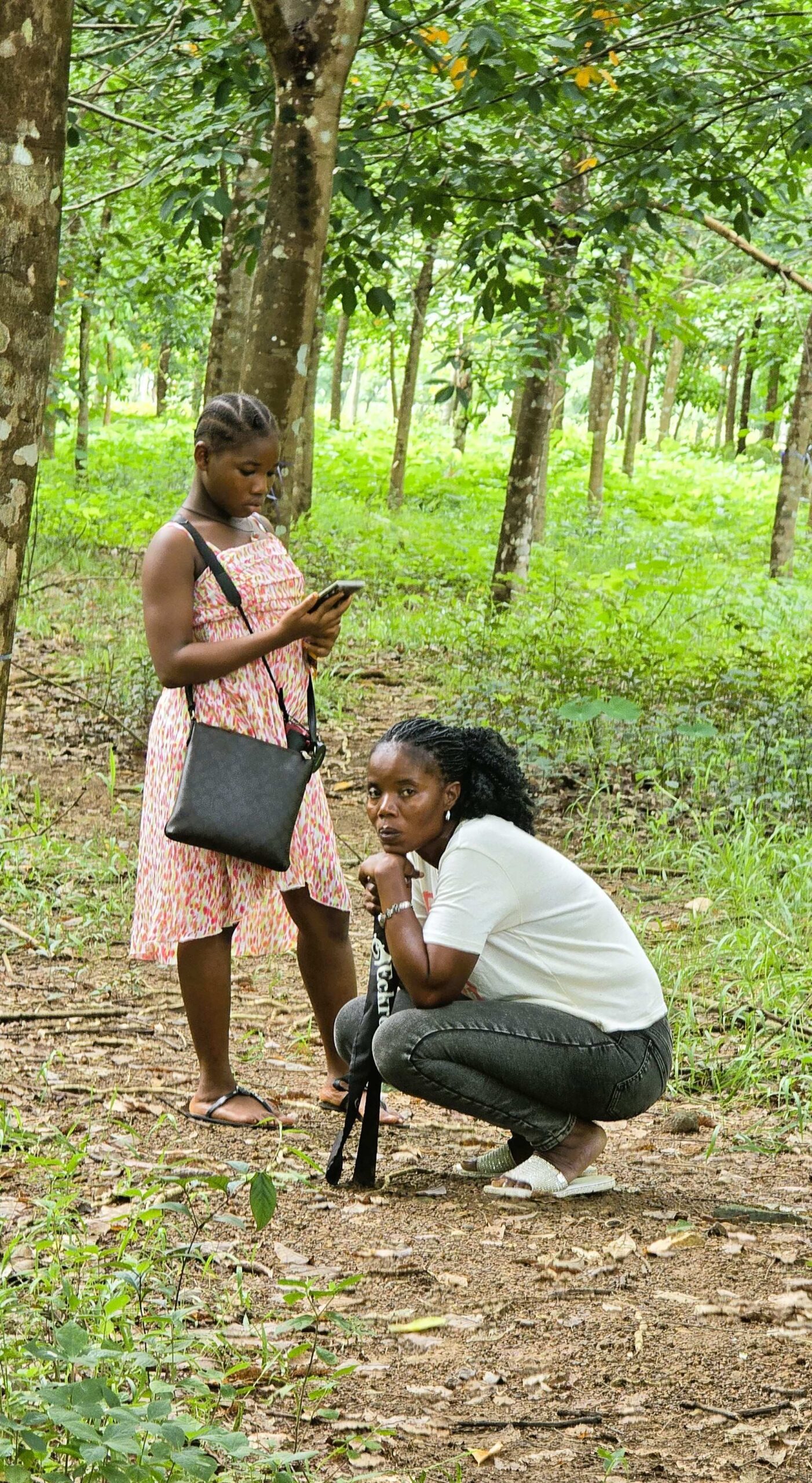
Banner photograph shows Global Ekklesia’s intern Photographer Ruth Gaye and her niece, Little Success taking a break from a walk to the memorial site June 6, 2025.
“For the Carter Camp victims, it was immediately decided by aid workers in collaboration with government authorities that the bodies of dead victims should be buried nearby due to the state of mutilation. Without much burial ritual, several mass graves were dug and the remains of 600 plus, were hastily interred”-Carter Camp: 20 Years after the Massacre-article by J. Fasuekoi/New Dawn, Feb. 24, 2012

By James Kokulo Fasuekoi|Editor-Publisher
From the Carter Camp Memorial in Firestone, Liberia
ALL PHOTOGRAPHS BY RUTH GAYE & JAMES KOKULO FASUEKOI

On Friday, June 6, 2025, I awoke from bed, ready to travel the 45 miles journey to Harbel, Firestone in order to get to Carter Camp, the site of the June 6, 1993, mass murders of civilians, living in a large Laboral camp-some even with their entire families, and displaced by war.
At least more than 600 people, mostly women and children, got hacked to death just within a few hours during that fateful morning of June 6, with the youngest of victims as young as six-month-old or even younger. And they weren’t employees of Firestone, the Ohio owned tire & rubber company in Liberia.
And the mass killers’ choice of weapons? Red Cross and other local and international aid workers who stepped to the scene determined that the attackers may have used mostly silent weapons, possibly blunt objects, such as axes, monkey wrenches and machetes during their reign of terror! This was to keep the operation undetected till the killers got out.

The victims’ crimes for which they all perished in cold blood? Well, none was found. Except that those destitute people were found to be in the wrong place and at the wrong time! Moreover, one of the country’s erstwhile rebel factions (Taylor’s NPFL) was burning to settle a political score with the AFL and thus, staged the massacre.
Remember the vindictive Charles Taylor and his rag-tag rebels had been reeling from a terrible military defeat at the hands of ECOMOG, West African Peacekeeping Forces, that spearheaded the peace process. ECOMOG was assisted by a combination of warring factions including the AFL and mainstream ULIMO. The killings happened eight months later after Taylor’s bid to seize Monrovia failed October 15, 1992.
Feeling bitter over his military losses the NPFL devised other ways to cause some havoc to the city, ECOMOG and AFL troops. The front would send its Libyan-Burkinabe guerrillas to sneak through rubber farms-just a mile away, quickly murder civilians and move back. The motive? Tarnish the image of the national army (AFL), which occupied the area.

For a short while, the NPFL’s strategy seemed to have worked perfectly: at first almost all fingers pointed toward the AFL as the main culprits, or perpetrators of the Carter Camp genocide. That’s because, the AFL itself had fallen out of public favor earlier on during the war, the fact that its troops had been clearly responsible for a series of smaller and large-scale massacres.
At the time of the mass murders in 1993, I was only 29-year-old and working in Liberia as a foreign correspondent for The Associated Press while at the same time serving as editor for The Inquirer of Liberia.
Besides, I, together with a few prominent journalists including the late Mohammed Jalibah, were also taken to the Carter Camp’s massacre scenes under a military escort by Col. Arthur B. Dennis, former Defense Press Secretary of Liberia. This happened hours after news of the genocide broke out in Monrovia.

The massacre scene was a chaotic one, such that I hadn’t witnessed in my entire lifetime. This national tragedy took on an enormous proportion, one that no one imagined. Upon disembarking our vehicles, we were greeted by a huge swarm of flies from the direction of the camp.
And without much talking, we all followed the noisy flies, arriving at the ghastly massacre scene. The first sight my eyes caught was the opened torso of a baby, while the head of another, still strapped to its mother’s back in tattered clothes, was smashed-open with an object like a baseball bat.
With such horrifying experience, followed by my departure from the country in 1999, the Friday, June 6, trip, the 32nd anniversary of the genocide was to allow me pay homage to the victims hastily buried in shallow graves. Such event could have brought me some type of peace for my human spirit had been knotted to the tragedy since my first visit on the day of the killings.

But to my utmost disappointment, there was no national observance, or a ceremony to mark the genocide’s 32nd anniversary, a mass murder that claimed world’s attention. Not only that; the stretch of narrow road, used by visitors to get to the memorial site (which now sits in a thick rubber grove), was completely covered by heavy grass.
I thought this was very odd for a genocide of such magnitude, just as the St. Peter’s Lutheran Church genocide: both have close proximity to the capital and so-called “rights activists and civil society leaders,” and most recently, the Office of the Establishment of War & Economy Crimes Court (OEWECC), having all used them to make a case to the international community in their “fight” to end impunity in Liberia.


Without much delay I sought out Rev. George Monhin, a pastor who has been running the Aladura Church (one of few structures left in the camp), since 2009. I asked whether people had visited the mass gravesite lately or that June 6 morning. I also inquired if there had been any ceremony at the memorial before our arrival?
I was escorted by Mrs. Ruth G. Gaye and her little niece, Success, and we arrived at 9:30 A.M. Liberian time. Global Ekklesia’s intern photographer, Ruth Gaye, was too young to remember the Firestone genocide as she was only 7-year-old at the time of the mass murders in 1993, and living in a Liberian refugee camp in Guinea, with her mom. Success, born 2013, wasn’t around either.

It turned out, no one, except one family, had visited the site to pay homage to the beloved deceased; that happened after Ruth and I last visited the site May 3, 2025, according to Rev. Monhin. Rev. Monhin stays in the village daily and takes count of almost every visitor who comes by to spend quiet time at the memorial, and we had encountered him on most of my trips.
Feeling unsettled, I quickly reached for cutlass in my car, then walked to the back of Pastor Monhin’s shabby housing unit where the road to the site begins.
Out of sheer anger I brushed the road, using my whole strength. And I began to question our own individual sincerity and commitment in relation to our so-called fight to bring “justice” to those innocents departed ones who died simply because of evil men who reigned terror over the land. (May God Almighty reward them according to their deeds, especially if they refused to genuinely repent).

Unbeknown to me I stepped in a colony of army ants as I brushed through to the rubber plantation. I hadn’t noticed that I had chopped off into the colony, thereby provoking the carnivorous predatory ants to pursue me but Ruth sounded an alarm, although by then they had gone wild all over my trekking shoes!
Moving faster I managed to get past the hill of “army ants” and soon landed into the clearing under the rubber grove. The memorial stood quietly before us, under a gloomy sky. All this time Ruth had the cameras, while Little Success held onto another, shooting pictures.
Without much talking, Ruth and Success sat on a cement bench next to the memorial while I quietly but gently walked, going into circle around the mass grave, something that I had often done whenever I visit the site.
Our visit ended with a prayer asking God to preserve the souls of the departed victims!

Liberia’s post-war recovery process: massacre series