
Amid border dispute, Yeala border looks calm. But Guinea’s flag still hovers over Liberian Land
By James Kokulo Fasuekoi|Editor-Publisher from the Yeala Border, Lofa County
ALL PHOTOGRAPHS BY AUTHOR & RUTH G. GAYE
On Sunday, March 15, 2026, our news team made one last move before departing Lofa County. We walked into the Yeala border costume (the main crossing into Guinea) to bid goodbye to agents of the Joint National Security Forces stationed there. Aside from the mere goodbye, we wanted to get hints of the prevailing security situation, whether or not the Sorluba-Konadu chaos was reverberating in Yeala.

Our move was in part, prompted by the fact that similar events now making headlines in Sorluba and Konadu borders with Guinea, in Lofa, first surfaced at the Yeala border, a few miles north of Zorzor City as far back as the mid 70s through the 80s, occasionally forcing district commissioners on both sides to intervene so as to prevent a catastrophic bloodbath but no one seemed to listen then.
Yeala Border still calm
We found the border town (which happens to be writer’s hometown) calm during our team’s visit. One costume agent (whose identity we won’t reveal) said, “Everything is fine,” unlike developments taking place in the Sorluba and now, Konadu regions, when asked.

“In fact, they cross [referring to Guinean soldiers], leaving their weapons across, come here and have fun and then go back to their checkpoint,” the agent revealed.
Much of the town’s population-mainly farmers and hunters and fishermen stayed away in their villages, at this time of the year, working to finish bush-clearing before the rice planting season can set in by April-May, the start of the wet season.
Many rarely know that Yeala stands out for its ancient war history, and one such artifact that still brings back the memories of war especially for visitors is the remains of a piece of wall/fort standing at the entrance of the town.

In fact, the town is strategically situated in a valley, almost below the Valagizi Mountain and once hosted one of Liberia’s key military garrisons similar to that of Camp Naama in Belefinein, Bong County. Though a wild bush has taken over the spot where the barracks once stood, one could still see pieces of broken walls there during the 70s and early 80s.
Yeala is a busy commercial route to Guinea, especially during summer in that drivers plying the route see it to be a blessing because it’s a short-cut to Guinea rather than using the Voinjama that might take a driver extra 4-5 hours to reach Mancenta.

Despite the ongoing land dispute in Sorluba and Konadu, roughly some 110 kilometers north of Zorzor, continues to heighten, it hasn’t impacted life in Yeala nor Zorzor either. Cargo trucks loaded with merchandise headed to Guinea sped past our car.
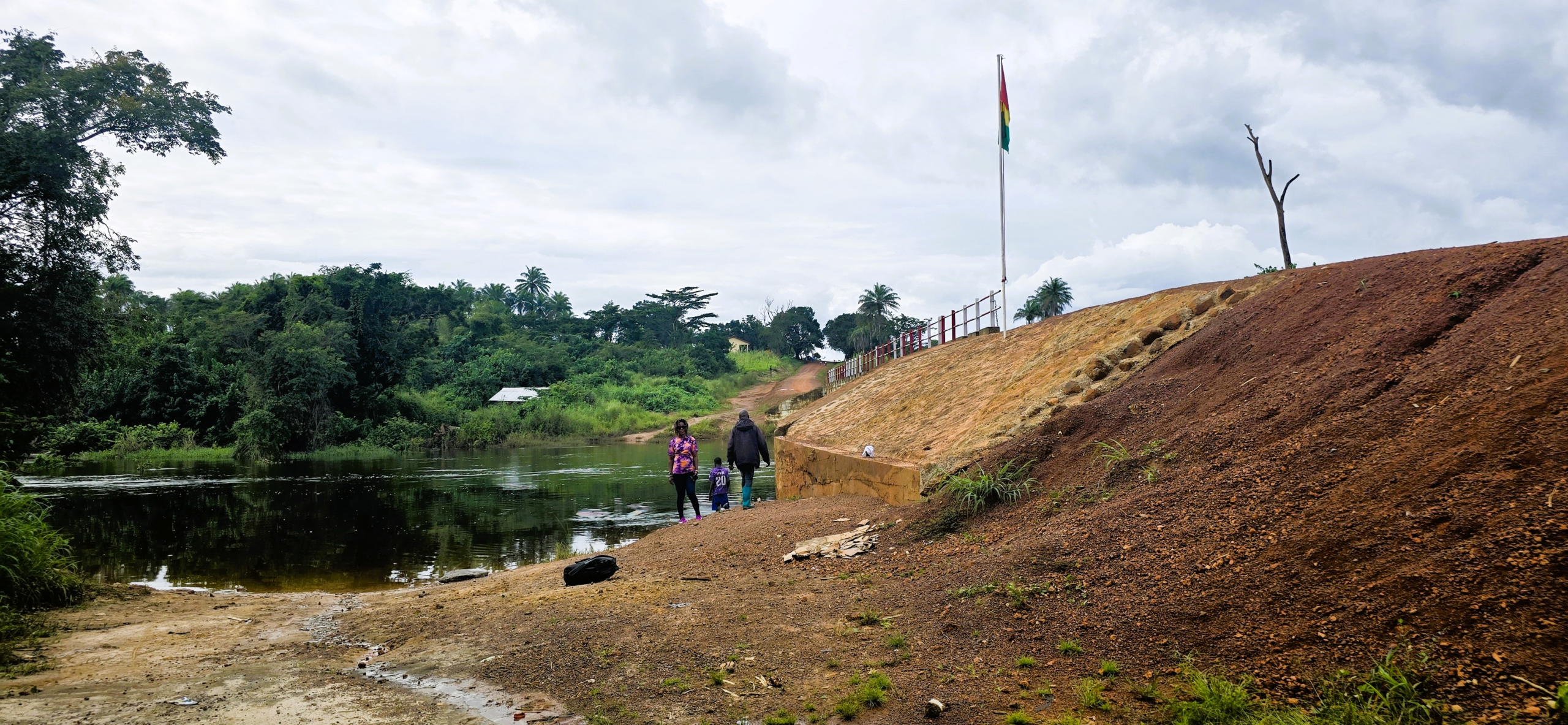
As much as this sounds like good news, the government of President Joseph Boakai, Sr. needs to pay close attention to the Yeala border where the Guinean National Red, Yellow & Green Flag still flies over Liberian land, so to prevent further encroachment as we’ve witnessed in the Sorluba area.
How did Guinea’s flag get there?
Until the first Liberian Civil War, Guinea’s National Flag stood for decades high on a hilltop at their checkpoint, just half a mile away from the border cornerstone post along the road to Koryama, the nearest district headquarters on Guinea’s side occupied predominantly by Lormas and Mandingos.

Nevertheless, the Guineans seemed to have taken advantage of the First War and planted their flag at the bank of the Monuyea River on the Liberian side. And the Guineans did so when ULIMO-K, led by late Alhaji Kromah occupied the Lofa region up till the national disarmament in 1996-97.
Liberian refugees, mainly from Lorma ethnic background returning home from Koryema for resettlement following the end of the war, first spotted the Guinean Flag mounted on Liberian soil and raised alarm.

A team of crack journalists/editors which included this writer, Moses Sandy and Willie Brewer, found Lofa County still under the occupation of rebels of Alhiji Kromah’s ULIMO-K in late December 1996, few months before disarmament commenced.
Our team was accompanying an anti-war ballet dance dramatic group around the country and on our way to Voinjama City, when ULIMO-K rebels halted our vehicle about midnight near the town of Konia and demanded a search but the ECOMG escort refused.

Three rebel warring factions had heavily contested over Lofa County-rich in agricultural and other natural minerals, including gold and diamond. It changed hands between Lofa Defense Forces, NPFL and ULIMO-K at various periods, before Kromah’s fighters finally gained the upper hand.
The West African Multinational Peacekeeping Forces, ECOMOG, largely deployed U.N. Pakistani troops and Guinean ECOMOG soldiers in Lofa to carry out the disarmament of rebel fighters. Both Pakistani and the Guinean contingents were largely Muslims as ULIMO-K rebel fighters in Lofa at the time.
Background to the conflict:
The Yeala-Guinean border dispute has lingered on for a long period, escalating 1997-98, and although some of Charles Taylor’s and Samuel Doe’s fans now romanticize both men’s absence from the national scene, this gravest matter in fact existed under their own separate rules and none ever moved to resolve it.
For instance, under Mr. Taylor’s administration, a Joint National Security Team led by Gen. Saykajebo Kortor from the Ministry of National Defense reached Yeala and discovered the Guinea Flag planted on the Liberian side. This was while they were on a nationwide Joint Security Mission tour in 1999. We put the question before him as to whether he was “troubled” by the Guinean action and he answered positively.

Gen. Kortor promised he was in the process of writing a report on the Yeala based on his firsthand experience and submitting it to the government. Whether or not that happened we cannot tell.
To our recollection, former Zorzor District Commissioner Pewee Moneyaizi Howard, initiated some type of peace meeting over the Yeala border crisis with his Guinean counterparts about 1988. Meeting took place at the border and Journalists (including this writer) were barred from attending. The excuse? It was to be a “closed-door” as both sides had agreed, and because of fear the Guineans could misinterpret the media’s presence.
Until the mid 1970s, common activities like sand-mining, fishing, swimming and commercial canoeing in the Monuyea River took place without any incident. In fact, all of the towns along this river on both sides are occupied predominantly by Lorma People and it dates back to ancient times when their own ancestors set foot to the soil and established the settlement.

Belonging to a single affinity, residents of Kpawu, the first and closest Guinean Lorma Town-from the Yeala border crossing point, occasionally crossed over for soccer matches and even participated in traditional rites per a longstanding tradition. Yeala likewise reciprocated and the two enjoyed a cordial relation for long till Guinea began replacing Kissi-Kpelle speaking border guards with ethnic Sou-Sou and Mendika-Mandingo speaking guards.
It turned out that the new arrivals had little regard for the cultures of the peoples they met living on both sides of the aisle and rather than exhibit respect and cultivate good friendship with these people as their predecessors had done, they appeared very territorial and acted mean to Liberians residing along the border or traveling to Guinea.
Supt. Massaquoi’s timely move
Now, the current Lofa County Superintendent Mr. J. Lavela Massaquoi did something bold that no Liberian leader has done as far as the history involving these land disputes is concerned. He politely asked the Guinean soldiers who moved their flag near Konadu to take it back to its initial “position” on the Guinean side.
Although this request might have sounded very “uncomfortable” to the aggressors, the “Massaquoi Move” is how you first begin to deal with such unprovoked “aggression” from a neighboring nation like Guinea while waiting to settle at the peace or “diplomatic table.”
Perhaps, if Samuel Doe, Charles Taylor, or even former Zorzor District Commissioner, Moneyeizi-Howard had confronted the Yeala border dispute in such a manner as Hon. Lavela Massaquoi did, it would today perhaps be a totally different story!
