


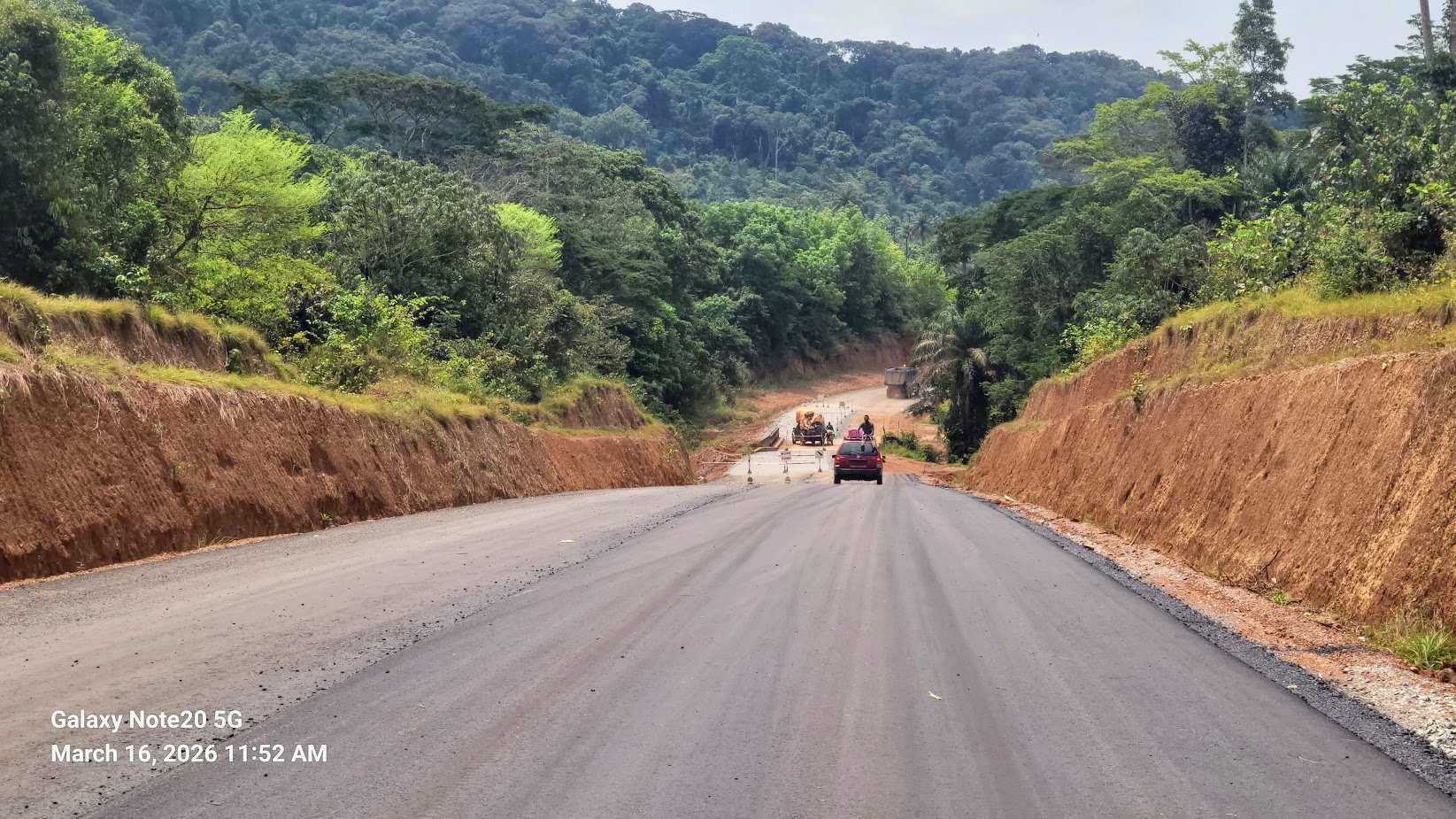
Lofa citizens ought to be thankful. New asphalt-paved road hits Salayea, Zorzor next!
Guinea’s border dispute with Liberia, lately, created confusion enough to divert public attention from other good jobs the current government has begun. The diversion was intense that some of our countrymen who earlier planned to travel to back home and do investments decided in some cases, to seek me out and hear news concerning the security situation in the country. As we report in this development-oriented piece (with graphic photographs), Liberia, nevertheless remains a Paradise in waiting!

By James Kokulo Fasuekoi|Editor-Publisher from Zorzor, Lofa, now reporting from Minnesota, USA.
ALL PHOTOGRAPHS BY RUTH G. GAYE & AUTHOR

Even if there were to be any unfolding news event strong enough to attract attention nationwide, it certainly wouldn’t do much to dissuade citizens of Salayea and Zorzor districts from focusing, talking about their new Asphalted Road, now well-past Salayea itself and fast approaching Zorzor, Lofa County.
In fact, as of March 14, 2026, the Asphalted Road pavement was already beyond Salayea itself, a key cocoa and coffee producing town which happens to be this region’s main seat or district headquarters.

Hopefully, without much interruption from heavy rainfall this April and May, the project appears to be set to cover the 50 kilometer (about 30 miles) stretch of dirt road from Salayea to Zorzor, another crossroad mission town, probably the largest agricultural district in all of this region.
The latest development is particularly good news for people of Bong and Lofa who had to go through unending pains just to travel through these regions for over five decades before and after two civil wars. Now, instead spending 4-5 hours to cover a 104 kilometer distance (between Gbarnga and Zorzor), they can now do so within a minimum of two and half or less.
It means locals in those areas and frequent travelers alike no longer have to go through headaches, or worry about some “problematic sections” of the road that once caused enormous nightmare or sleeplessness for travelers particularly near the Telemai and Salayea areas, all Kpelle settlements.
Before the ongoing road pavement: These photographs shot in summer at a deplorable area, near Salayea itself, Sept. 2024, show the nightmare travelers endured during decades of neglect and underdevelopment.


But the good news doesn’t end there; some near the town of Gbalatuah (next to St. Paul River) also have good reasons to be glad at such a news in that contractors have managed to knock off much of the “Man-Por-Hill” Mountain (actually pronounced “Maa-Pouryea” in Kpelle). That mountain stood for decades on this highway as a snare, causing multiple car accidents and leaving some travelers dead.
Dangerously situated, the steep mountain practically sat between two valleys. The curvy but narrow motor roadway that ran down the steep mountain, compounded by the steady flow of stream throughout the summer and rainy season created serious safety issues making the area too dangerous for commercial cars such as cargo trucks drivers.
For many of the people of Bong and Lofa, including students from the erstwhile nearby ALL GIRLS boarding Gbalatuah Mission School-many of them hailing from remote parts of Liberia, “Man Poryea” clearly represented an object of fear! My wife, Martha Fasuekoi, from Grand Bassa, attended the mission in the mid 80s, and vividly recalls the steep mountain.
After new asphalt pavement: The below photographs show Lofa Highway, taken exactly two weeks ago following the road’s pavement. The immediate photograph of Publisher seen below shows the terrain where “Man Poryea” once stood.

“Did they [contractors] knock-off “Man Poryea”? Martha, my wife for more than ten years, asked the moment I told her of the road pavement on my arrival in the U.S. two weeks ago.
“Yes, of course…! They’ve turned it into a smooth little hill between the valleys,” I said, amid chuckles, explaining that it took us less than three hours to drive from Gbarnga to Zorzor. Thanks to President Joseph Nyuma Boakai, Sr. and also former President George M. Weah who, according to sources, started this project before leaving office.


Quite interestingly, the new Lofa road project has brought increased commerce to the region especially beyond the St. Paul River Bridge on the Lofa County side. Between Zorzor and Salayea, for instance, we saw a mound of fresh watermelon sitting beside the road for sale.
Like other cars, headed to Monrovia, we stopped to purchase some. However, we soon got disappointed at the price for a single watermelon weighing around 4-5 lbs. as harvesters placed their prices around LD $500 to $800, pretty much the same, if found in Monrovia, the capital.

And that’s exactly what good national road development offers, making life fascinating and more enjoyable, while giving local farmers or agricultural producers their labors’ worth.
Meanwhile, in the capital itself, President Boakai, Sr. has embarked on two major modern-day projects, involving construction of two overpass bridges in Congo Town, Monrovia. One sits opposite the new EJS Ministerial Complex, and the next, close to the T.B. Annex.
Works on the two massive projects remain intense, with contractors continuing work nonstop, working Sundays, in attempts to finish on schedule. Once finished, they would certainly form part of major road developments in Liberia’s modern history, with the name President Joseph Nyuma Boakai, imprinted on them.
Editor’s Note: Global Ekklesia is a Christian News Magazine with no political affiliation to any political party or group worldwide. We also support Developmental Journalism.